
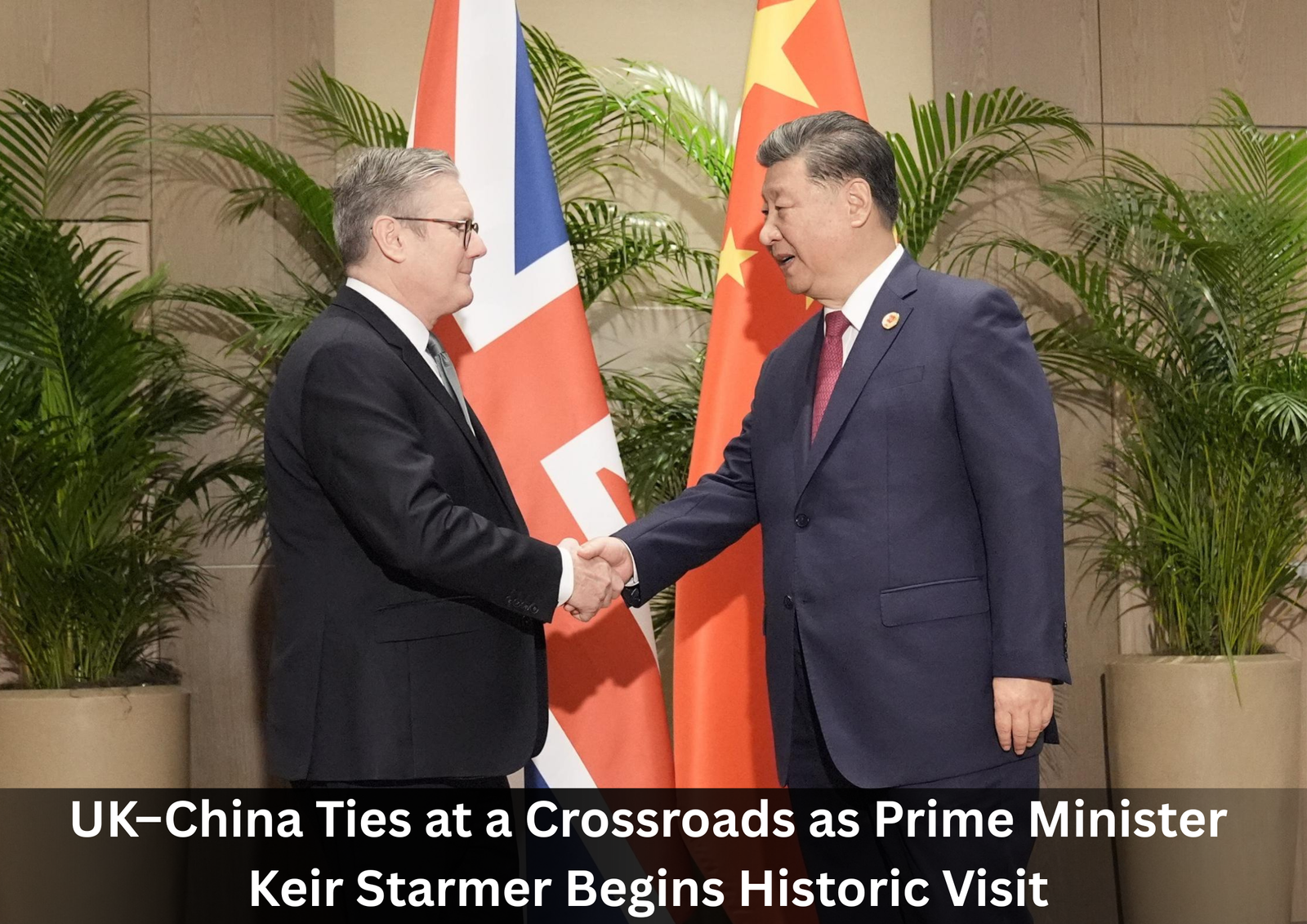
British Prime Minister Keir Starmer arrived in China on Tuesday, launching a three-day visit that many analysts describe as a cautious attempt to recalibrate one of the United Kingdom’s most complex international relationships. The trip marks the first official visit by a UK prime minister to China since 2018 and comes at a time of heightened global economic uncertainty and shifting geopolitical alliances.
Starmer’s itinerary includes meetings in Beijing and Shanghai with China’s top leadership, including President Xi Jinping and Premier Li Qiang. Accompanied by Chancellor Rachel Reeves, Business Secretary Peter Kyle, and a delegation representing more than 50 British companies and institutions, the prime minister is seeking to reopen channels of economic cooperation while reinforcing Britain’s national security priorities.
Downing Street has framed the visit as pragmatic rather than transformational. Officials say the goal is to stabilize economic ties, explore targeted areas of cooperation, and maintain open dialogue on sensitive political issues without committing the UK to a definitive geopolitical bloc.
Economic Reset Amid Trade Imbalances
Economic relations are central to the visit, though expectations for major breakthroughs remain modest. The UK’s trade deficit with China has expanded significantly over the past seven years, rising from approximately £17 billion in 2018 to an estimated £42 billion by 2025. British officials are expected to raise concerns about market access and investment imbalances, particularly in manufacturing, healthcare, financial services, and technology.
Policy analysts caution that concrete outcomes are likely to be limited to memoranda of understanding or sector-specific cooperation agreements rather than large-scale trade deals. China’s recent overseas investment behavior – including corporate listings shifting away from the United States toward Asian markets – has also shaped discussions, highlighting Beijing’s increasingly cautious approach to global expansion.
Still, business leaders within the UK delegation argue that re-engagement is necessary. Some see potential openings in green technology, renewable energy infrastructure, and financial services, where British expertise remains internationally competitive.
Navigating Global Power Pressures
Starmer’s visit unfolds against a backdrop of renewed tensions between Washington and Beijing. With the United States under President Donald Trump signaling tougher trade measures and tariff threats, several European governments have sought steadier engagement with China to reduce economic volatility.
The British prime minister has repeatedly emphasized that the UK will not be forced into choosing between China and the United States. Speaking ahead of the trip, Starmer said Britain’s foreign policy would remain “strategic, sovereign, and security-led,” underscoring that economic cooperation would not come at the expense of national interests.
Other European leaders, including the prime ministers of Finland and Ireland, have recently made similar diplomatic visits to China, reflecting a broader recalibration across the continent as global power dynamics evolve.
Security, Rights, and Domestic Scrutiny
Despite the economic focus, the visit is not without controversy at home. Critics argue that London risks softening its stance on national security and human rights in exchange for limited commercial returns. Concerns include cyber security, foreign influence, and the approval of plans for a large Chinese embassy complex in London – a decision that has sparked debate within Parliament.
Human rights issues are expected to be raised privately during meetings, including the imprisonment of pro-democracy activist Jimmy Lai and broader concerns related to Hong Kong and Xinjiang. However, UK officials have made clear that these topics will not dominate the visit’s public agenda.
Starmer is also under domestic pressure regarding the future of British Steel in Scunthorpe, with unions and opposition figures urging the government to ensure China contributes fairly to costs tied to previous investments and supply arrangements.
Measured Expectations, Long-Term Impact
Supporters of the visit argue that diplomatic engagement, even when limited in scope, is preferable to isolation. Business groups have welcomed the reopening of high-level dialogue, saying stable communication channels are essential for long-term economic planning.
While no major free trade agreement is expected, officials say incremental cooperation could help rebuild trust and reduce volatility in bilateral relations. Any agreements reached are likely to shape the UK’s broader strategy toward China over the coming years, influencing trade policy, investment screening, and diplomatic alignment.
As Starmer’s meetings begin, both London and Beijing appear intent on managing expectations. The visit may not redefine the relationship overnight, but it signals a deliberate effort to navigate an increasingly fragmented global landscape with caution, balance, and strategic intent.
Before you miss crucial developments affecting Northeast rail travel, read the full analysis in “Gateway Tunnel Construction Nears Standstill Amid Prolonged Federal Funding Freeze” to understand what’s really at stake.