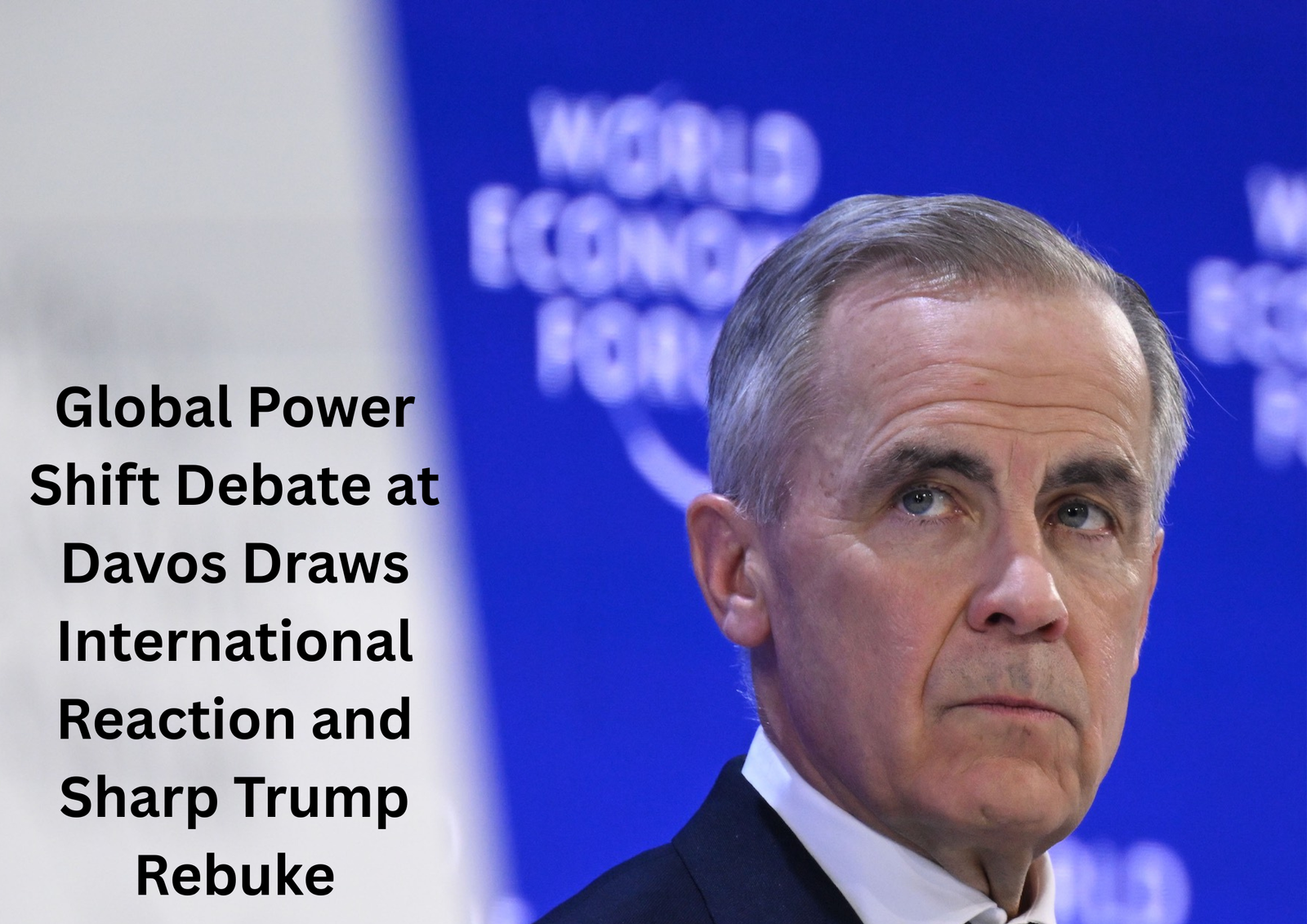
A forceful address by Canadian Prime Minister Mark Carney at the World Economic Forum has ignited worldwide discussion about the future of global leadership, after he argued that the post–Second World War system of international cooperation has effectively collapsed.
Speaking before political and business leaders in Davos, Carney said the world is no longer experiencing a gradual adjustment, but a decisive break from the past. According to him, the long-standing rules meant to limit the power of dominant nations are failing, giving way to an era where economic pressure and geopolitical rivalry increasingly shape international relations.
Without naming specific leaders, Carney criticized the growing use of trade measures and strategic threats among allies, saying such actions have eroded trust in the existing framework. He urged so-called “middle powers” to strengthen their own economies and cooperate more closely to resist political or economic intimidation from any major power.
Carney also suggested that reliance on a single global leader is no longer realistic. He acknowledged that the old system had flaws, but said it once helped prevent open conflict and supported shared prosperity. In his view, recent developments have stripped that system of credibility, forcing nations to rethink how they protect their interests.
The comments drew a swift and pointed reaction from the U.S. President Donald Trump, who addressed the issue during his own appearance at the forum. Trump dismissed Carney’s remarks and emphasized the depth of Canada’s economic ties to the United States, framing them as evidence of American leverage rather than vulnerability.
Observers noted that the exchange underscores rising tension between traditional allies, particularly as countries reassess trade dependencies and seek new partnerships in Asia and elsewhere. Canadian officials have already signaled interest in diversifying exports to reduce exposure to political uncertainty.
Carney’s speech was widely discussed among other governments attending Davos. Several current and former officials from allied nations praised the address as a candid reflection of changing realities, while others cautioned that open confrontation among partners could deepen global instability.
Beyond the immediate political fallout, analysts say the speech may mark a broader shift in how mid-sized economies view their role on the world stage. Rather than aligning automatically with major powers, they may increasingly prioritize collective resilience and flexible alliances.
As debates continue in diplomatic circles, Carney’s message has clearly resonated beyond the conference halls, highlighting growing doubts about the durability of the global order that has shaped international relations for decades.
Don’t miss this deep dive on “EU Freezes US Trade Talks as Tariff Dispute Over Greenland Intensifies”-read the full blog to understand the stakes, key players, and global economic impact.