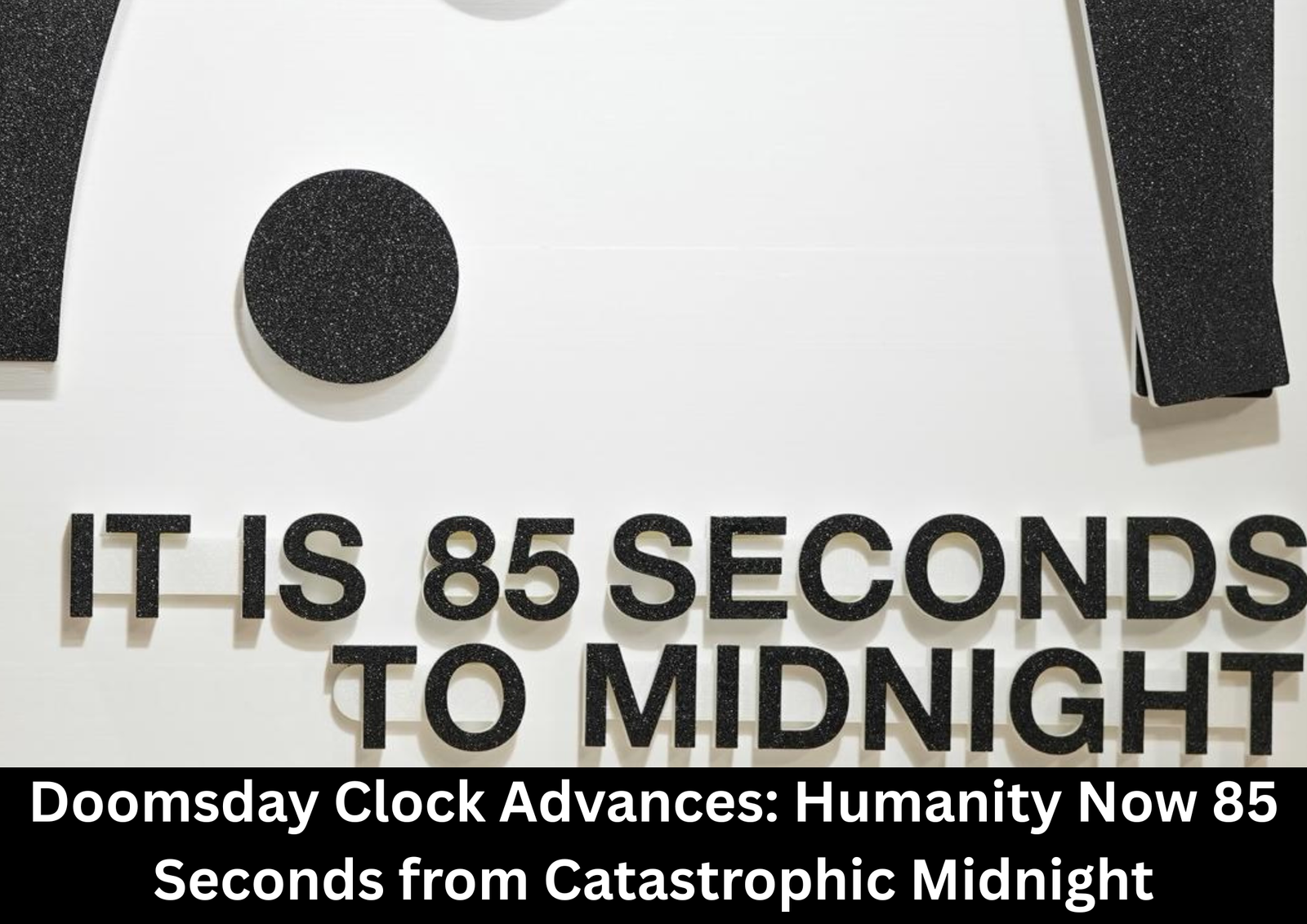
Scientists behind the renowned Doomsday Clock have set the symbolic time at 85 seconds to midnight, marking the closest humanity has ever come to what they describe as a potential global catastrophe. The announcement was made Tuesday by the Bulletin of the Atomic Scientists, underscoring growing concern over multiple, accelerating threats facing the world.
The Doomsday Clock is not a literal countdown but a metaphor used for nearly eight decades to reflect how close civilization is to self-inflicted disaster. According to the Bulletin, the decision to move the clock forward reflects worsening conditions across nuclear security, climate change, emerging technologies, and global governance.
Bulletin President and CEO Alexandra Bell said the warning is becoming more urgent each year. She noted that progress toward reducing existential risks has stalled while dangers continue to intensify. Nuclear tensions among major powers, she explained, are rising at a moment when long-standing arms control frameworks are weakening or disappearing altogether.
One of the most pressing concerns highlighted this year is the possible expiration of the last remaining treaty limiting U.S. and Russian nuclear arsenals. Scientists warn that without such agreements, the world could enter a new and unpredictable arms race, increasing the likelihood of miscalculation or conflict.
Climate change also played a significant role in the clock’s adjustment. Researchers pointed to record-high carbon dioxide levels, rising seas, and increasingly severe weather events across the globe. Extreme heat, floods, droughts, and wildfires are no longer isolated incidents, scientists say, but persistent patterns that threaten food security, infrastructure, and human health.
Another growing factor is the rapid advancement of artificial intelligence and other disruptive technologies. Experts cautioned that AI can amplify misinformation, weaken public trust, and complicate decision-making during crises. Concerns were also raised about future AI-driven weapons systems and unregulated developments in biotechnology, areas where international rules have yet to catch up with innovation.
Beyond physical threats, the Bulletin emphasized the role of political instability and the breakdown of shared facts. The rise of authoritarian governance, combined with widespread disinformation, has made global cooperation increasingly difficult. Without trust in institutions or reliable information, scientists argue, coordinated action on global risks becomes nearly impossible.
The Doomsday Clock was first introduced in 1947 by scientists involved in the Manhattan Project, shortly after the atomic bombings of Hiroshima and Nagasaki. While it initially focused on nuclear danger, climate change was officially added in 2007, and emerging technologies have since become a growing part of the assessment.
Historically, the clock was farthest from midnight in 1991, set at 17 minutes, following the end of the Cold War. In recent years, however, the trend has steadily moved closer to midnight. The new 85-second setting surpasses all previous records.
Despite the alarming update, scientists stress that the situation is not hopeless. The threats pushing the clock forward are largely human-made, meaning they can also be reduced through informed public engagement, responsible leadership, and international cooperation.
Midnight on the clock represents a point where a catastrophic event could make large parts of the planet unlivable. The Bulletin says the goal of the clock is not to predict the future, but to spark action before it is too late.
Don’t miss the full breakdown of “India and European Union Finalize Major Trade Pact in Shift Toward Global Economic Realignment”-read this blog to understand its deep economic impact and global significance.