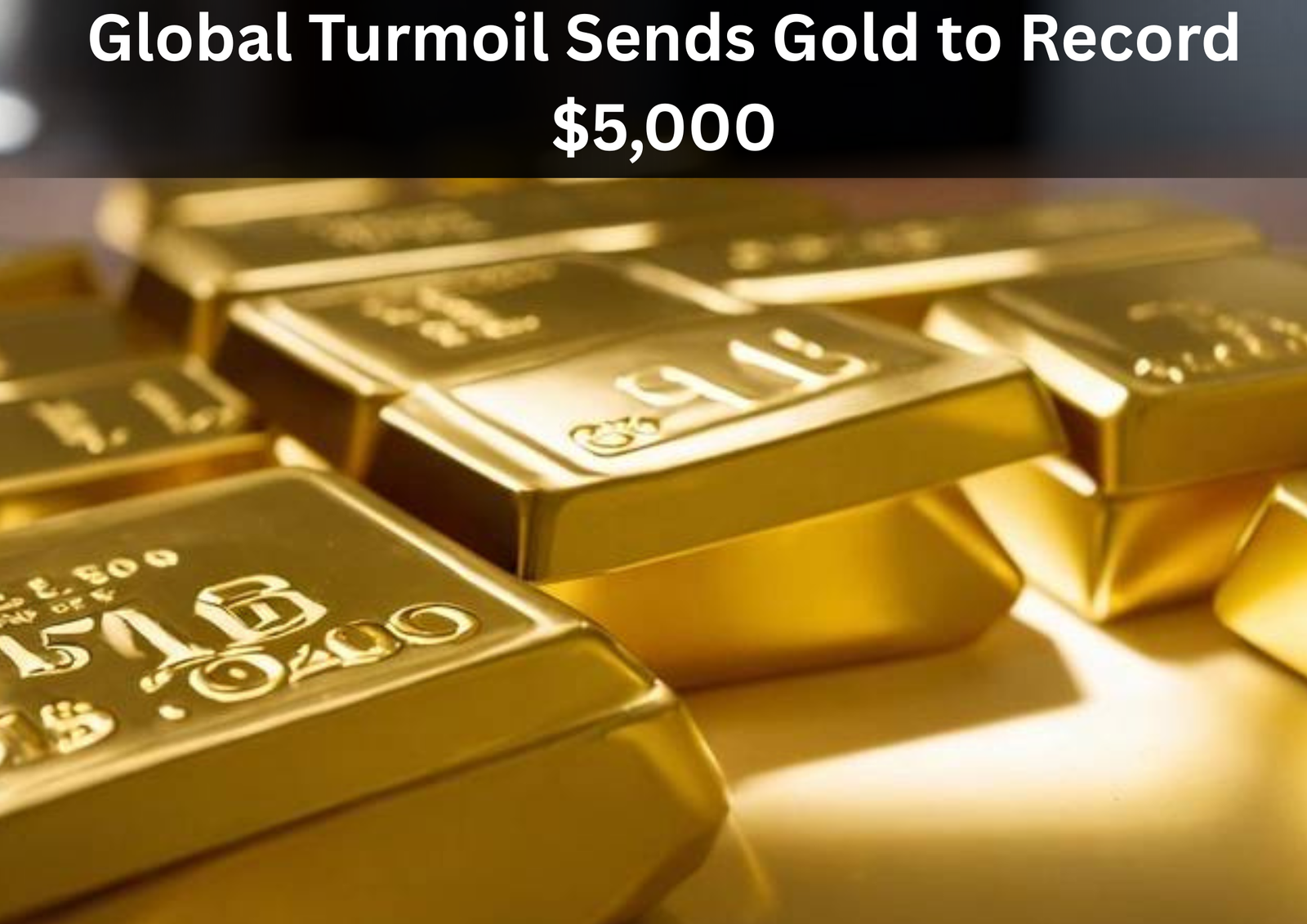
Gold prices surged to historic highs on Monday, crossing the $5,000-per-ounce threshold for the first time as investors worldwide rushed toward safe-haven assets amid escalating geopolitical and economic uncertainty.
Spot gold climbed more than 1% during the session, trading above $5,040 an ounce at its peak, while U.S. futures contracts settled just above $5,030. The move marks a defining moment in one of the strongest bull markets the precious metal has ever seen, with prices nearly doubling over the past year.
Market analysts attribute the rally to a growing sense of instability on multiple fronts. Rising geopolitical tensions, unpredictable trade policies, and mounting concerns over U.S. governance have combined to shake confidence in traditional financial markets. As a result, gold has reasserted its long-standing role as a store of value during turbulent times.
Political developments have played a central role in the surge. Recent diplomatic strains involving the United States and its allies, alongside aggressive trade rhetoric targeting key partners, have unsettled global markets. Investors have also been watching developments in Latin America and the Arctic region closely, viewing them as potential flashpoints with far-reaching economic consequences.
Uncertainty at home has further added to gold’s appeal. Ongoing legal scrutiny involving senior U.S. financial officials and renewed fears of a federal government shutdown have raised questions about institutional stability. These concerns have encouraged both institutional and retail investors to seek assets perceived as insulated from political risk.
Demand for gold is no longer limited to traditional buyers. Central banks have continued to accumulate bullion at a steady pace, reflecting a broader strategy to diversify reserves away from major currencies. At the same time, exchange-traded funds backed by physical gold have seen renewed inflows, while wealthy families and long-term investors increasingly view the metal as protection against policy shifts and currency weakness.
Major financial institutions have taken notice. Several global banks have raised their long-term price expectations, citing sustained demand and limited supply growth. Some forecasts suggest gold could climb further before the end of 2026 if current conditions persist.
Other precious metals have followed gold’s upward momentum. Silver prices rose sharply alongside gold, extending gains built over the past year. Analysts note that silver’s dual role as both an industrial and investment metal has amplified its price swings during periods of strong investor interest.
Market strategists say the rally reflects deeper structural concerns rather than short-term speculation. With government debt levels rising and confidence in fiat currencies under pressure, many investors view precious metals as a hedge against long-term financial erosion.
Still, not everyone expects a straight line upward. Some experts caution that gold’s rapid ascent leaves room for volatility, particularly if geopolitical tensions ease or economic data improves unexpectedly. Short-term pullbacks, they say, would not be unusual after such a steep climb.
Despite those warnings, sentiment remains broadly supportive. As long as political uncertainty, trade friction, and fiscal concerns dominate the global outlook, gold is likely to retain its shine. For now, the metal’s move beyond $5,000 stands as a powerful signal of how deeply uncertainty has reshaped investor behavior across the world.
“Don’t miss my other blog on Minnesota Leaders Across Business and Sports Urge Calm After Minneapolis Violence – a must-read for deeper insight into leadership responses and community impact.”