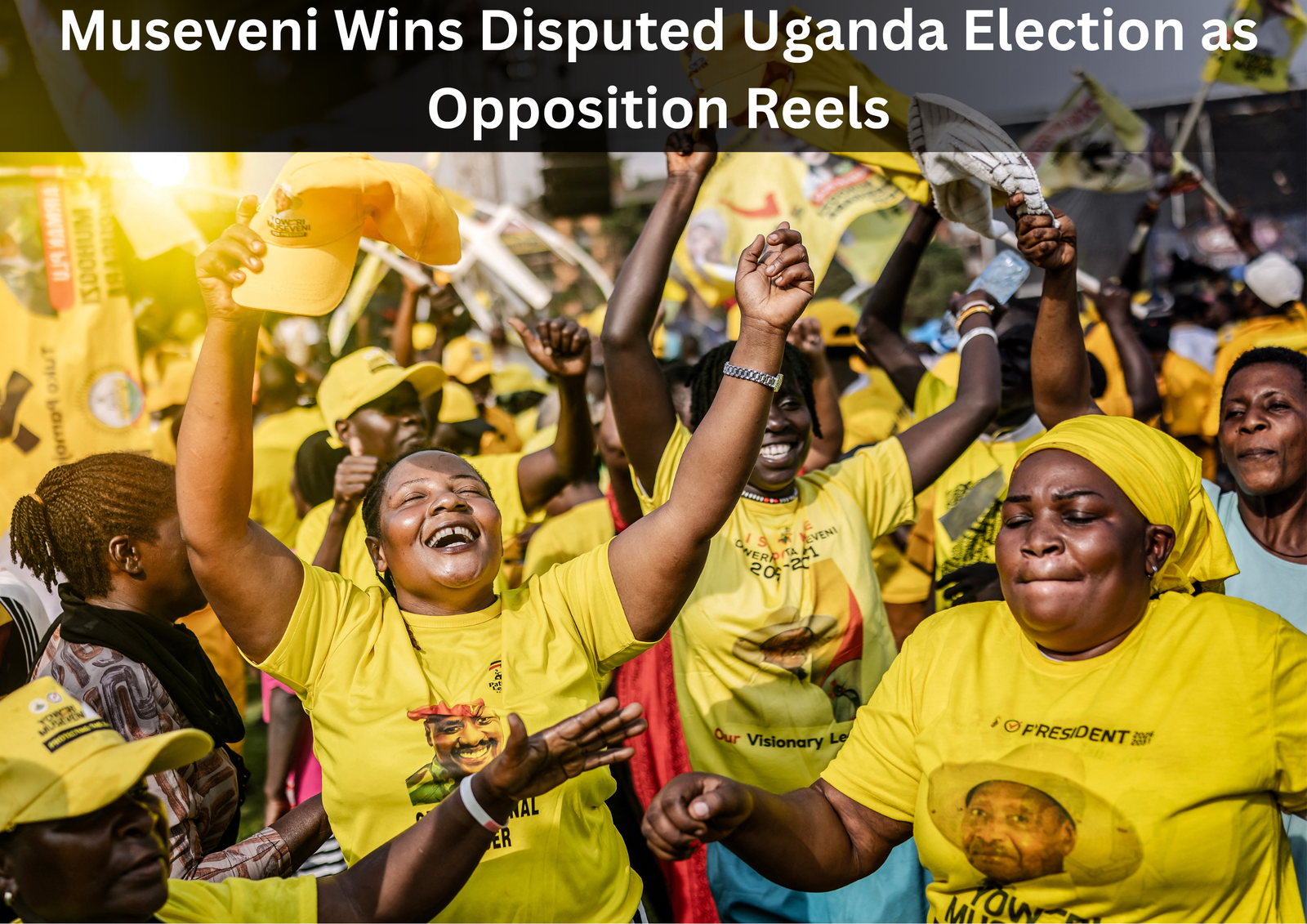
President Yoweri Museveni has been declared the victor of Uganda’s latest presidential contest, extending his tenure into a fifth decade and reinforcing the ruling National Resistance Movement’s (NRM) hold on power. Official figures released by the Electoral Commission on Saturday reported that the 81-year-old leader captured 72% of the national vote, while opposition figure Robert Kyagulanyi, widely known as Bobi Wine, finished with 25%.
Wine immediately rejected the outcome, calling the process “rigged” and alleging ballot manipulation and intimidation across several districts. Uganda’s government and electoral authorities have dismissed the allegations, and the African Union observer mission said it found no evidence of ballot stuffing during its monitoring activities. Six additional presidential candidates participated in the race, none gathering more than 2% support. Nationwide voter turnout stood at roughly 52.5%, according to election officials.
Unrest and an Intensified Security Response
The campaign and voting period unfolded under stringent security measures and sporadic violence. Wine claimed that more than 20 of his supporters were killed in the days surrounding the vote, while police acknowledged seven fatalities, attributing deaths in one incident in Butambala to what they called attacks on a police station by armed opposition “groups.”
Opposition lawmakers issued competing accounts, arguing that security forces were responsible for aggressive raids on supporters’ homes and gatherings. Conflicting versions of events have been difficult to verify due to an ongoing government-ordered internet shutdown that began on Tuesday, officially justified as a tool to limit misinformation and prevent unrest. The blackout drew concern from the United Nations human rights office and election observers from the East African Community, who said connectivity restrictions hindered transparency efforts.
In Kampala, residents reported an unusually heavy military deployment with soldiers closing shops and clearing streets as results were released.
Confusion Over the Opposition Leader’s Whereabouts
Wine’s status after the vote became an evolving political flashpoint. On Friday, the opposition leader said he was under house arrest. Hours later, his party claimed on social media that he had been seized and flown by helicopter to an unconfirmed location. Uganda’s military swiftly rejected the assertions as fabricated, saying detractors were attempting to fuel public panic.
Wine resurfaced online on Saturday, announcing that he had escaped an alleged attempt to detain him and was in hiding for his own safety. His wife and children, he added, remained confined at their residence. Police officials stated that movement around Wine’s home was restricted because of what they described as “security considerations.”
Campaign Conditions and Observer Concerns
The months preceding the vote were marked by widespread limits on opposition activity, including the disruption of rallies by tear gas, arrests of campaign staff, and reports of live ammunition being used during confrontations. Wine’s youth-oriented platform resonated strongly among Uganda’s large population of voters under 30, while Museveni emphasized economic stability, security, and oil-driven development goals, promising to move Uganda into middle-income status by 2030.
International observer groups expressed concern over arrests, intimidation, and digital restrictions throughout the campaign. Former Nigerian President Goodluck Jonathan, who led the African Union mission, urged authorities to ensure safety and transparency, noting that fear among voters undermines democratic participation.
Succession Signals and Internal Party Dynamics
Analysts noted that while the election extended Museveni’s long rule, it also spotlighted internal restructuring within the NRM. Increasing attention has centered on Gen. Muhoozi Kainerugaba, the president’s son and current Chief of Defence Forces. For the first time, he holds consolidated control over both internal and external security portfolios, a development viewed by political observers as indicative of future leadership planning.
Sources familiar with the presidency describe a decentralized governance arrangement, with family members overseeing different policy domains, including diplomatic relations and economic affairs. The configuration has fueled speculation regarding succession timing and whether formal power may shift gradually rather than abruptly.
Wine’s reduced vote share compared to his 2021 performance has further stirred debate about his long-term political prospects amid persistent state pressure and legal challenges.
EU Freezes Trade Negotiations with U.S. Following Fresh Tariff Threats – get the full story and understand why tensions are escalating by reading this blog now!