
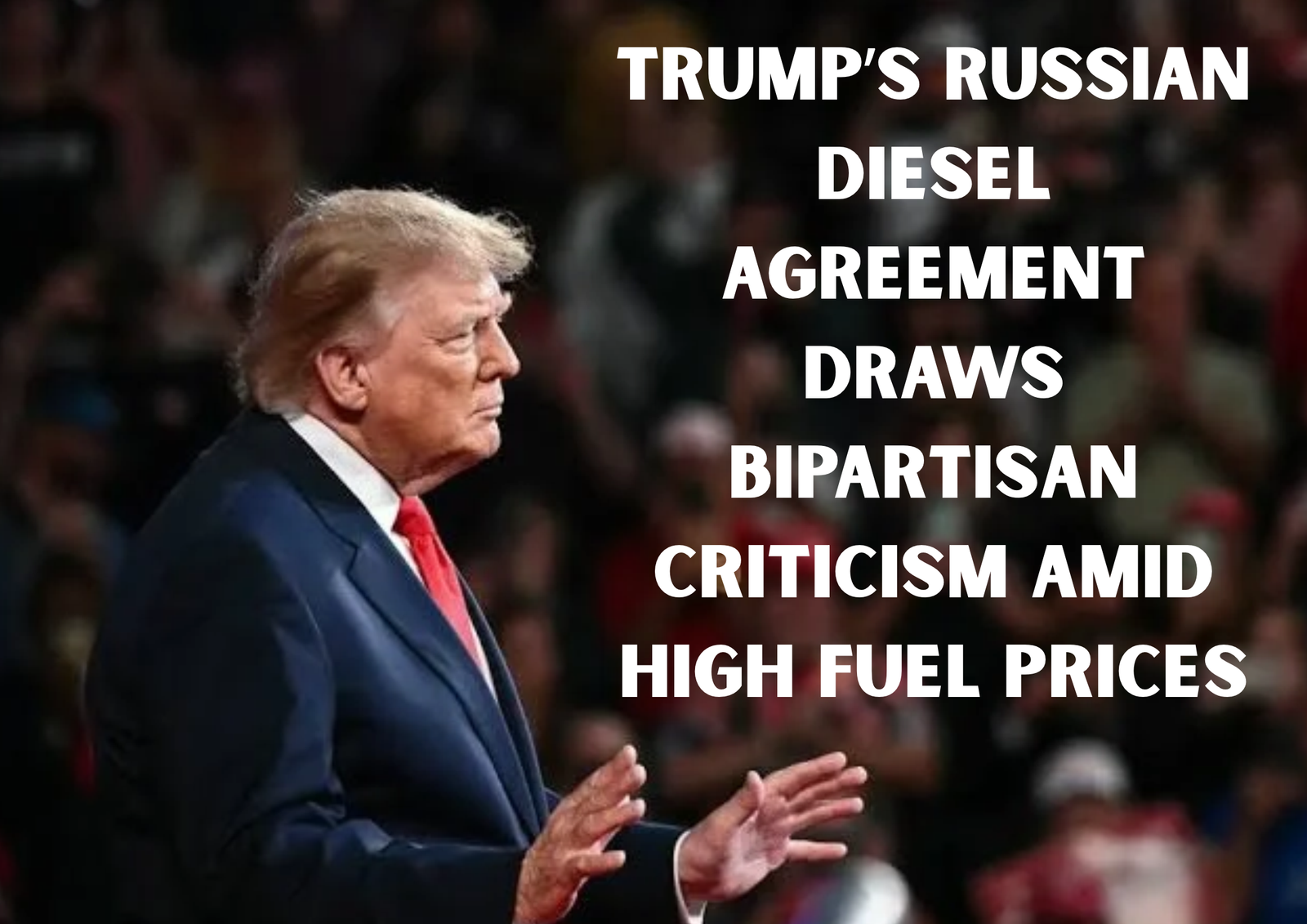
President Donald Trump is facing growing criticism from both Republicans and Democrats after his administration temporarily eased sanctions on Russian diesel imports, a move intended to increase fuel supplies and help bring down energy prices.
The decision has triggered a political dispute over whether reducing fuel costs for American consumers justifies allowing Russian energy products back into the U.S. market while Moscow continues its war against Ukraine.
The administration’s move comes at a time when elevated energy prices are putting pressure on American households and creating a significant political challenge for the White House ahead of the midterm elections.
Temporary Sanctions Relief Raises Questions
The U.S. Treasury Department temporarily relaxed restrictions on Russian diesel on Friday, allowing imports until April. Trump said Russian President Vladimir Putin had agreed to make diesel available to the global market as part of an effort to ease pressure on fuel prices.
The president defended the decision, arguing that the government must prioritize the interests of American consumers and address the high cost of energy.
However, critics say the policy risks undermining the sanctions imposed on Russia following its full-scale invasion of Ukraine in February 2022. Those restrictions were designed, in part, to limit Moscow’s energy revenues and reduce the financial resources available to support its military campaign.
The controversy has placed the administration between two competing objectives: providing short-term economic relief at home and maintaining pressure on the Russian government.
Republicans Join Democrats in Opposing the Move
Opposition to the decision has extended beyond Democratic lawmakers, with several Republicans also questioning the administration’s approach.
Seven members of the Senate Foreign Relations Committee, including four Republicans and three Democrats, argued that permitting Russian diesel imports conflicts with a 2022 law restricting Russian energy purchases. They urged the administration to reverse the decision, warning that payments for Russian energy could indirectly support Moscow’s war effort.
Republican Sen. Jerry Moran of Kansas also criticized the move, arguing that Washington should strengthen restrictions on Russia rather than create additional opportunities for Russian energy sales.
In the House of Representatives, Republican Rep. Don Bacon of Nebraska accused Trump of taking an overly accommodating position toward Putin. Republican Rep. Brian Fitzpatrick of Pennsylvania said he would introduce bipartisan legislation aimed at blocking purchases of Russian oil.
Former Vice President Mike Pence also condemned the decision, arguing that easing sanctions could provide financial assistance to Russia’s military campaign.
Democratic leaders have similarly criticized the policy, questioning whether the potential economic benefits outweigh the diplomatic and security risks.
White House Defends the Decision on Economic Grounds
Despite the criticism, some Republicans have defended Trump’s decision as a difficult but necessary step to reduce energy costs.
Sen. John Barrasso of Wyoming said the president was focused on lowering energy expenses for American families while balancing the broader objective of ending the war in Ukraine. Rep. Anna Paulina Luna of Florida also expressed support, arguing that the arrangement could benefit American consumers.
The administration’s position reflects growing concern over the economic consequences of elevated energy prices. Higher fuel costs can increase transportation and shipping expenses, putting additional pressure on businesses and consumers. Diesel prices are particularly important because the fuel powers much of the country’s freight transportation, agricultural machinery and commercial vehicle fleet.
The administration is therefore seeking to expand available supplies in the hope that additional fuel entering the market will help moderate prices. However, the actual impact will depend on the volume of imports, market conditions and whether the additional supply translates into lower costs for consumers.
Dispute Over Russia’s Commitment to an Energy Ceasefire
The sanctions decision has also intensified questions about the broader diplomatic relationship between Washington and Moscow.
Trump said Sunday that Russia and Ukraine had agreed to an energy ceasefire. Ukrainian President Volodymyr Zelensky, however, disputed that characterization, saying no such agreement had been reached. He also indicated that Russian attacks on Ukrainian energy infrastructure were continuing.
The disagreement highlights the difficulty of securing reliable commitments from both sides as diplomatic efforts continue. It also complicates the administration’s argument that engagement with Moscow can simultaneously support peace efforts and deliver economic benefits.
For critics of the diesel arrangement, the continued attacks on Ukraine’s energy facilities reinforce concerns that easing restrictions could reward Russia without securing meaningful concessions.
Energy Prices and Midterm Politics
The dispute carries significant political implications as the United States approaches its midterm elections. The cost of living remains a major concern for voters, and energy prices have become an important measure of the administration’s economic performance.
Republicans face pressure to demonstrate that the government can reduce household expenses, while Democrats are using the sanctions decision to question the president’s approach to Russia and national security.
The disagreement within the Republican Party is particularly notable because it demonstrates that support for lowering fuel prices does not necessarily translate into agreement over how to deal with Moscow.
Some lawmakers view temporary sanctions relief as a practical response to economic pressure. Others argue that weakening restrictions could damage U.S. credibility and give Russia additional financial resources during its war against Ukraine.
What Happens Next?
The central question is whether temporarily allowing Russian diesel imports will produce meaningful relief at the pump without weakening the broader sanctions strategy.
Even if additional supplies help ease market pressure, the scale and speed of any price reduction remain uncertain. Energy markets respond to multiple factors, including geopolitical developments, transportation costs, production levels and expectations about future supply.
The administration must also contend with congressional opposition and the possibility of legislative efforts to block Russian energy purchases.
For now, Trump is defending the arrangement as a decision made in the interests of American consumers, while critics are demanding stronger measures against Russia. The outcome could influence not only U.S. energy policy but also Washington’s approach to the war in Ukraine and its relationship with Moscow.
The debate ultimately reflects a difficult policy trade-off: whether short-term relief from high fuel prices can be achieved without compromising the long-term economic and diplomatic pressure intended to constrain Russia.