
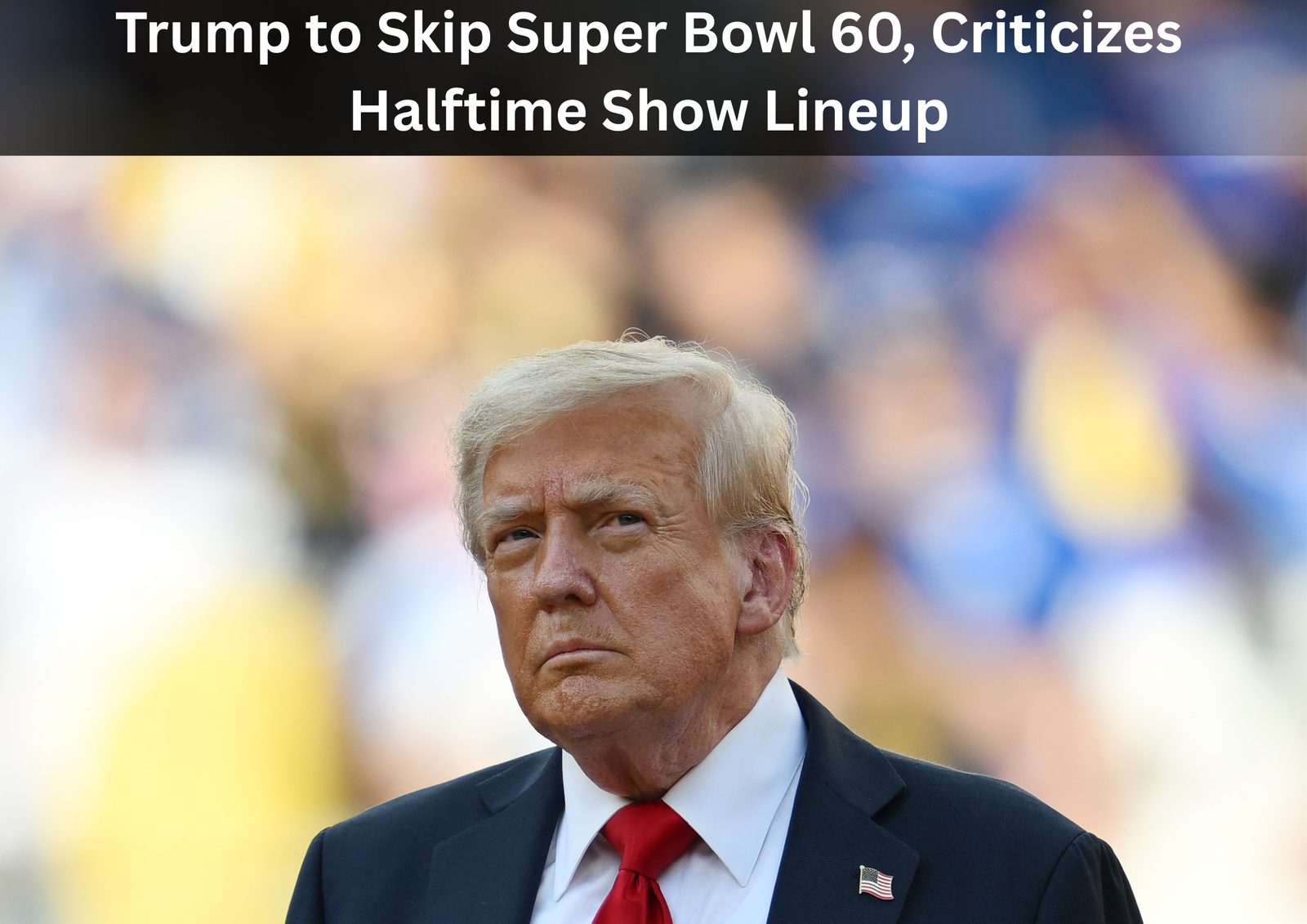
U.S. President Donald Trump has confirmed that he will not attend Super Bowl 60, despite receiving an invitation to the highly anticipated sporting event. The championship game, scheduled for the 2026 NFL season, will take place at Levi’s Stadium in Santa Clara, California.
Trump made his decision public in comments given to the New York Post, where he stated plainly that he does not plan to attend the game. While declining the invitation, he also shared his reasoning, pointing to long-standing political disagreements with the state of California and its leadership.
According to Trump, attending a major event in California would conflict with his outspoken criticism of the state’s policies. He explained that he did not want to appear inconsistent by participating in a high-profile event hosted in a region he frequently challenges on political and governance issues. This stance aligns with his broader pattern of publicly distancing himself from institutions or locations he views as politically opposed to his views.
In addition to his comments about the location, Trump also addressed the Super Bowl’s halftime entertainment, which is set to feature performances by Bad Bunny and Green Day. He expressed strong disapproval of the selected artists, questioning both their musical appeal and the motivations behind their inclusion. Trump suggested that the halftime lineup reflected political considerations rather than entertainment value, a claim that has added fuel to ongoing cultural debates surrounding the event.
The halftime show has already sparked discussion beyond Trump’s remarks. Several conservative commentators have criticized the choice of performers, arguing that the artists represent viewpoints that do not resonate with all audiences. Both Bad Bunny and Green Day have previously expressed political opinions that contrast sharply with Trump’s positions, which has contributed to the polarized response.
Media outlets have confirmed that Trump did receive an invitation to Super Bowl 60, although it remains unclear whether the invitation was extended directly by the NFL or through another organizing entity. Regardless of the source, Trump’s decision to decline has drawn widespread attention, in part because presidents often attend major national sporting events as symbolic gestures of unity.
Trump also indicated that, instead of attending in person, he would likely watch the game from one of his own properties. This approach mirrors his past behavior; during his presidency, he did not attend a Super Bowl in person, opting instead to observe the event privately.
Observers note that Trump’s announcement fits into a broader pattern of cultural and political division surrounding major entertainment events. In recent years, Super Bowl halftime shows have increasingly become focal points for debate, with discussions extending beyond music to include politics, representation, and public messaging.
The Guardian has highlighted that Trump’s remarks come at a time when public reactions to entertainment choices are often shaped by ideological perspectives. The Super Bowl, once viewed primarily as a unifying sports spectacle, has increasingly found itself at the center of broader societal conversations.
As Super Bowl 60 approaches, attention is expected to remain high, both for the game itself and for the discussions surrounding its cultural impact. While Trump’s absence may not affect the event’s scale or viewership, his comments have ensured that the intersection of sports, politics, and entertainment remains firmly in the public spotlight.
To understand how Google Confirms Gemini AI’s Role in Gmail, Offers Users Full Control Over Inbox Scanning, read the full blog for clear insights into privacy, features, and user control.