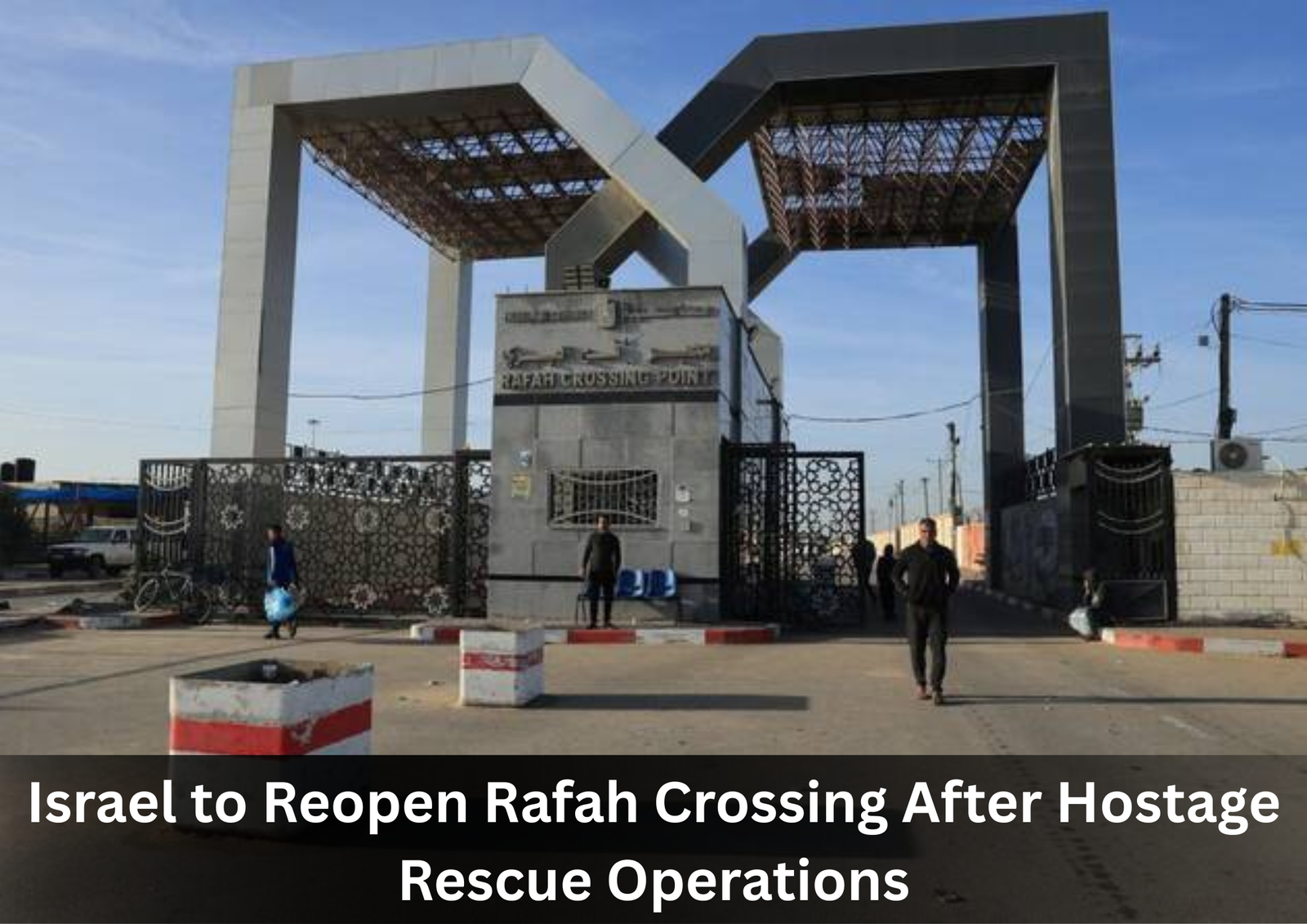
Israeli authorities have announced plans to partially reopen the Rafah border crossing between Gaza and Egypt after concluding a military operation aimed at recovering the remains of the final Israeli hostage believed to be held in Gaza.
According to a statement released Sunday by the office of Prime Minister Benjamin Netanyahu, the reopening will take place only after the Israeli military completes its search for Master Sgt. Ran Gvili, a police officer whose body has not yet been recovered. The operation is described as a targeted effort focused on northern Gaza, including areas near Israeli-controlled zones and specific neighborhoods where intelligence suggested potential burial sites.
Once reopened, the Rafah crossing will initially allow pedestrian movement only and will operate under a comprehensive Israeli inspection system. No commercial or large-scale humanitarian transport will be permitted at this stage.
The Rafah crossing serves as Gaza’s primary gateway to the outside world for most of its more than two million residents. Since 2024, the Gaza-side of the crossing has remained under Israeli military control, significantly restricting movement and aid access. Its reopening was a key component of a ceasefire agreement brokered by the United States in October 2025.
Under the terms of the agreement, Israel conditioned the reopening on the return of all living hostages and full cooperation in locating the remains of those who died in captivity. While all other hostages have been accounted for, Gvili’s remains remain the last unresolved issue. U.S. officials have recently stated that the ceasefire has entered a second phase, which includes reconstruction planning and additional Israeli troop withdrawals, increasing diplomatic pressure to reopen the crossing.
Hamas officials said they have already shared all available information regarding the location of Gvili’s remains with mediators and accused Israel of delaying recovery efforts in areas under its control. Israeli officials, however, maintain that Hamas has not provided sufficient cooperation. Gvili’s family has publicly urged the government to delay further ceasefire steps until his remains are returned.
Security analysts and humanitarian observers have raised concerns about the nature of the reopening. They warn that a pedestrian-only crossing could enable long-term population shifts by allowing residents to leave Gaza without guaranteeing their return. Additionally, aid organizations note that the limited reopening will not resolve critical shortages, as food, medical supplies, and reconstruction materials cannot pass through under the current restrictions.
Despite the ceasefire agreement, violence has continued in several areas. Palestinian health officials reported that recent Israeli strikes resulted in multiple deaths and injuries across northern and southern Gaza. Since the ceasefire began in October, hundreds of Palestinians have reportedly been killed, adding to the heavy toll of the previous two-year conflict.
In a separate development, a fire broke out overnight at the closed headquarters of the United Nations agency for Palestinian refugees in East Jerusalem. UN officials reported damage to the compound and alleged looting by Israeli settlers. The incident comes amid ongoing tensions surrounding the agency’s presence, following Israeli legislation passed in 2024 that barred its operations in areas claimed by Israel.
As negotiations continue and recovery efforts remain underway, the reopening of Rafah remains a closely watched indicator of whether the fragile ceasefire can move forward toward stability and reconstruction.
Don’t miss the full analysis in “China Launches Rare Probe Into Top Military Leaders as Leadership Shake-Up Deepens”-read the complete blog to understand the power shifts shaping China’s military future.