
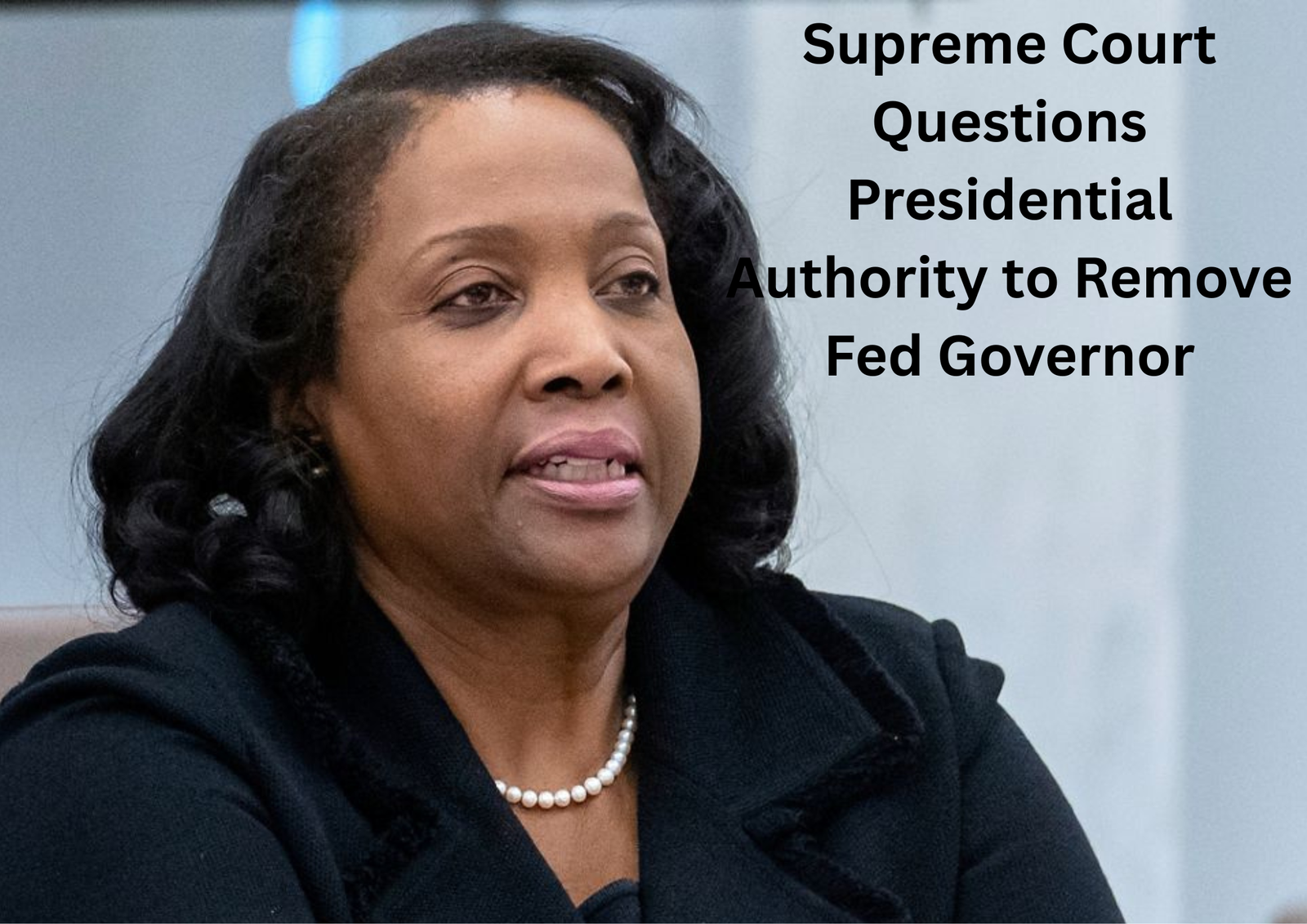
The U.S. Supreme Court signaled broad skepticism on Wednesday toward President Donald Trump’s attempt to remove Federal Reserve Governor Lisa Cook, with justices from across the ideological spectrum questioning whether the move undermines the central bank’s long-standing independence.
During nearly two hours of oral arguments, both conservative and liberal justices expressed concern that allowing a president to dismiss a Federal Reserve Board governor with minimal process could open the door to political interference in monetary policy. Several members of the Court suggested that the administration’s interpretation of presidential authority risks weakening statutory protections designed to insulate the Fed from short-term political pressure.
A Dispute With Broad Economic Implications
The case stems from President Trump’s August decision to fire Cook, citing allegations that she misrepresented information on mortgage loan documents related to two properties. Cook, who denies any wrongdoing, challenged the dismissal in court, arguing that it violated both federal law and her constitutional right to due process. Lower courts blocked her removal while the lawsuit proceeds, prompting the administration to seek emergency relief from the Supreme Court.
At the heart of the dispute is the meaning of the Federal Reserve Act’s requirement that governors may be removed only “for cause.” The justices probed whether that standard permits a president to act unilaterally, without providing the accused official a meaningful opportunity to respond or allowing courts to review whether sufficient cause actually exists.
Conservative Justices Voice Caution
Notably, several conservative justices appeared uneasy with the administration’s position. Justice Brett Kavanaugh warned that a loosely defined removal power could erode the Fed’s independence, cautioning that future presidents might use minor or politically motivated allegations to reshape the central bank. He emphasized that weakening institutional safeguards could have long-term consequences beyond any single administration.
Chief Justice John Roberts pressed government attorneys on whether courts would have any role at all if a president’s determination of “cause” were deemed unreviewable. Other justices questioned the urgency of the administration’s request, suggesting there was little harm in allowing the litigation to play out before taking irreversible action.
Competing Views of the Allegations
The administration argues that Cook’s alleged conduct meets the legal threshold for removal, characterizing the discrepancies in her mortgage filings as serious enough to justify dismissal. Cook’s legal team countered that the claims rely on selective readings of documents and ignore clarifications elsewhere in the loan files. Her attorney maintained that there was no intent to deceive and no criminal conduct, describing the case as an overreach that threatens statutory protections enacted by Congress.
Searching for a Narrow Resolution
Rather than settling the full scope of presidential removal power, the justices appeared interested in a narrower path-one that would address whether Cook’s procedural rights were violated while leaving broader constitutional questions for another day. Several suggested that, at a minimum, she should remain in her position while lower courts continue to examine the merits of the case.
High-Profile Attendance Underscores Stakes
The hearing drew unusual attention, with Cook present in the courtroom alongside Federal Reserve Chair Jerome Powell and other current and former Fed officials. Their attendance was widely interpreted as a show of institutional solidarity, highlighting concerns that political pressure could influence decisions on interest rates and economic stability.
In a statement following the arguments, Cook said the case goes beyond her individual role, framing it as a test of whether economic policy will be guided by evidence and independent judgment rather than partisan interests.
What Comes Next
Because the matter reached the Court on an emergency basis, a decision could arrive relatively quickly, potentially before the end of the current term. A ruling against the administration would not resolve the underlying lawsuit but would likely keep Cook in office while the broader legal questions continue to work their way through the courts.
Legal analysts note that the outcome could shape future disputes over presidential authority and the independence of federal agencies-issues with far-reaching implications for governance, markets, and public trust.
Don’t miss this detailed breakdown-Severe Winter Storm Fern Spreads Ice, Snow, and Extreme Cold Across the United States, revealing impacts, safety tips, and what to expect next across regions.