
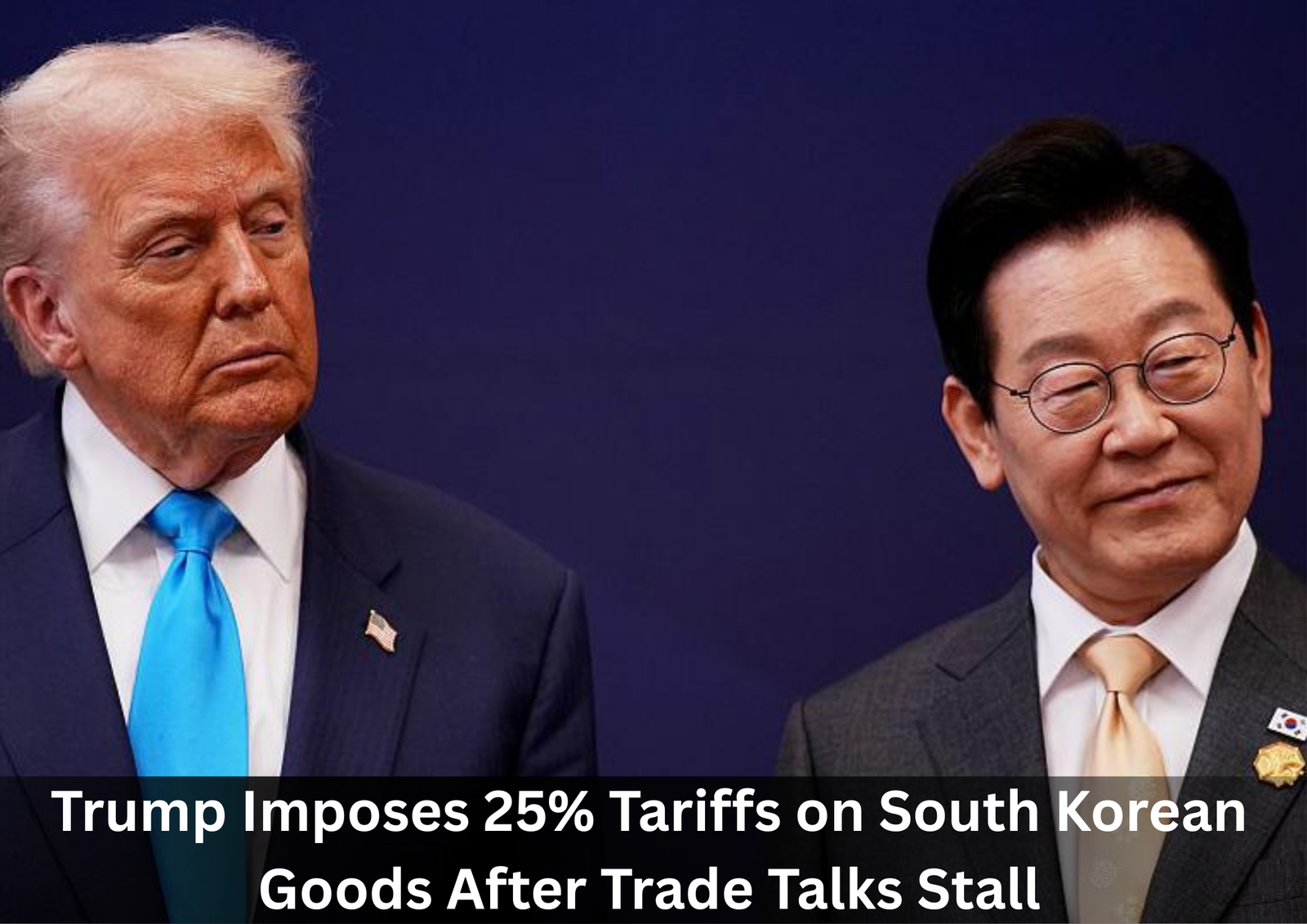
U.S. President Donald Trump has announced a significant increase in tariffs on imports from South Korea, lifting duties from 15% to 25% after accusing Seoul of stalling approval of a bilateral trade agreement finalized last year.
The announcement was made through a social media statement, where Trump said the decision was prompted by delays within South Korea’s National Assembly. According to Trump, the United States had already implemented its side of the agreement, including tariff reductions, while South Korean lawmakers had yet to complete the required ratification process.
The higher tariffs are set to affect a broad range of South Korean exports, including automobiles, construction materials, pharmaceutical products, and other goods covered under reciprocal trade measures. The trade pact in question was initially reached in late July 2025 and later reaffirmed during Trump’s visit to South Korea in October. While the agreement was formally submitted to the South Korean legislature in November, it remains under review, with passage expected in the coming weeks.
South Korean officials reacted cautiously to the announcement, stating that no formal notification had been received from Washington. A senior adviser to the South Korean president indicated that emergency discussions would be held among relevant ministries to assess possible responses. Industry Minister Kim Jung-kwan, currently attending meetings in Canada, is expected to travel to the United States soon for urgent consultations with U.S. Commerce Secretary Howard Lutnick.
Financial markets in South Korea showed immediate volatility following the news. Shares of major automakers, including Hyundai Motor and Kia, fell sharply in early trading before recovering some losses. The benchmark Kospi index initially declined but later stabilized, supported by gains in major technology firms such as Samsung Electronics and SK Hynix.
The trade agreement at the center of the dispute includes a commitment by South Korea to invest hundreds of billions of dollars into the U.S. economy, with a portion earmarked for shipbuilding and manufacturing projects. South Korea remains one of the United States’ largest trading partners, exporting more than $130 billion in goods annually, led by vehicles, semiconductors, and consumer electronics.
The tariff hike is part of a broader pattern of trade pressure. In recent days, Trump has issued warnings to other nations over potential trade alignments, including a threat of steep tariffs on Canada should it pursue closer economic ties with China. Similar warnings directed at several European allies were later softened.
Meanwhile, the scope of presidential authority to impose sweeping tariffs without congressional approval remains under scrutiny. The U.S. Supreme Court heard arguments late last year challenging such unilateral trade actions, and a ruling is still pending. Legal experts say the decision could have lasting implications for future U.S. trade policy.
Read my blog titled “Border Patrol Leader Reassigned After Minneapolis Shooting Triggers Federal and State Clash” to understand the full story and why this issue matters so much.