
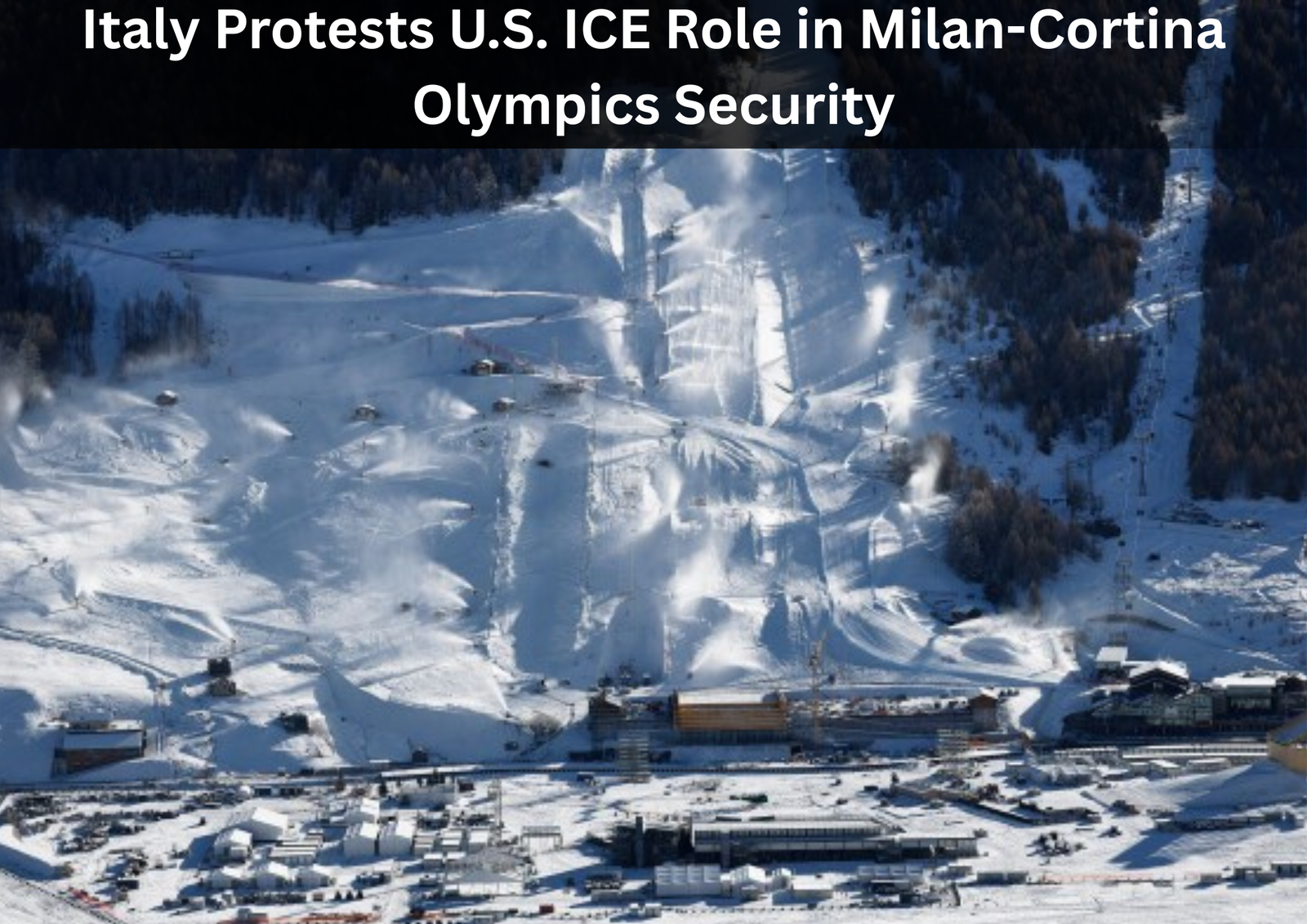
A growing political dispute has emerged in Italy after confirmation that agents linked to the U.S. Immigration and Customs Enforcement agency will take part in security coordination surrounding the upcoming Milan-Cortina Winter Olympics.
The controversy began after the U.S. Department of Homeland Security announced that personnel from ICE’s Homeland Security Investigations unit would assist American diplomatic security teams during the Games. While U.S. officials emphasized that the agents will not conduct law enforcement activities on Italian soil, the news has triggered sharp criticism from Italian leaders across the political spectrum.
The Winter Olympics are set to open on February 6, with U.S. Vice President JD Vance and Secretary of State Marco Rubio expected to attend. More than 200 American athletes are scheduled to compete, making the U.S. delegation one of the largest foreign presences at the event.
DHS officials stated that the involvement of Homeland Security Investigations is limited to intelligence coordination and risk assessment related to transnational criminal threats. According to agency representatives, the unit will work alongside the U.S. State Department’s Diplomatic Security Service and Italian authorities, with all operational control remaining firmly under Italian jurisdiction.
Despite these assurances, several prominent Italian politicians have publicly condemned the decision. Milan Mayor Giuseppe Sala described the presence of ICE-linked personnel as unacceptable, citing recent fatal incidents involving U.S. immigration enforcement officers in Minneapolis. He questioned whether Italy should allow participation by an agency he believes does not align with European standards of democratic policing.
Former Prime Minister Giuseppe Conte echoed those concerns, urging the Italian government to prevent the agents from entering the country. Other political figures, including Carlo Calenda, criticized the move as unnecessary and dangerous, arguing that Olympic security should be handled exclusively by Italian forces.
Members of Italy’s current right-wing government have attempted to defuse the backlash. Foreign Minister Antonio Tajani stressed that the agents involved are not street-level enforcement officers and will not operate publicly. He clarified that the personnel will remain inside U.S. diplomatic facilities and contribute only to internal coordination efforts.
Interior Minister Matteo Piantedosi later confirmed that the U.S. security team will be limited to investigative staff working from the American consulate in Milan. He emphasized that Italian police, Carabinieri, and the Guardia di Finanza will retain full responsibility for public safety throughout the Games.
The outrage has been amplified by incidents in Minneapolis earlier this month, where two U.S. citizens were killed during separate encounters involving federal immigration and border officers. The events, along with reported confrontations between ICE officials and Italian journalists covering the aftermath, have received widespread attention in Italian media and shaped public perception.
As of now, Italian authorities maintain that no foreign law enforcement agency will be allowed to conduct operations on national territory. U.S. officials continue to insist that their role is purely supportive, focused on intelligence sharing and diplomatic protection during the high-profile international event.
For deeper insight into how “Federal Court Rejects Virginia Congressional Map Over Racial Gerrymandering Concerns” could reshape elections and representation, read the full analysis in this blog.