



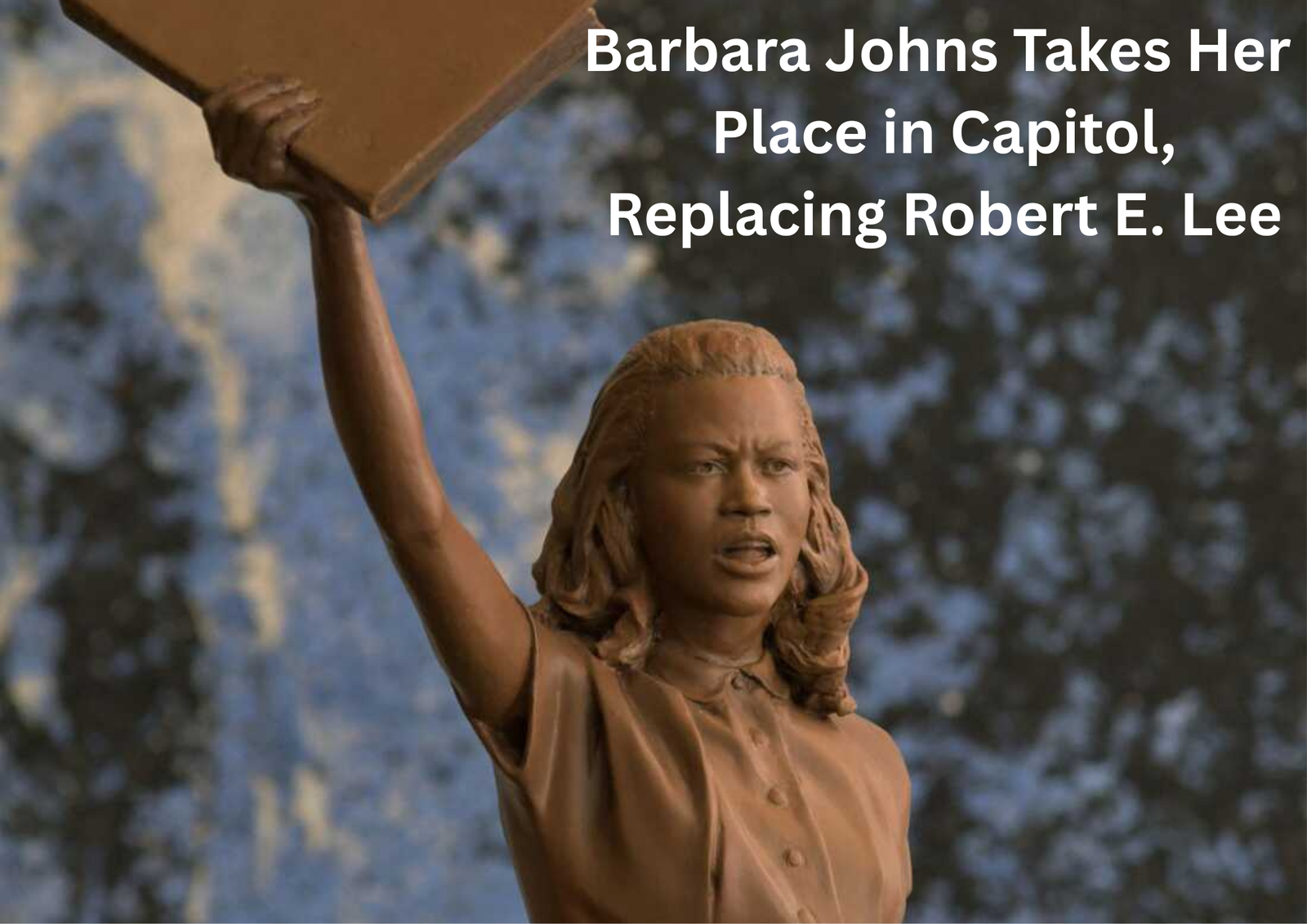
The U.S. Capitol has unveiled a new statue honoring Barbara Rose Johns, a teenage civil rights activist whose leadership helped ignite the legal battle that ended school segregation in America. The bronze monument now represents Virginia in the National Statuary Hall Collection, replacing a statue of Confederate General Robert E. Lee that stood for more than a century.
The sculpture, standing 11 feet tall, depicts Johns at age 16 as she addresses fellow students during a pivotal protest in 1951. She is shown raising a worn schoolbook above her head, symbolizing both protest and hope. The artwork was created by Maryland-based sculptor Steven Weitzman and installed in Emancipation Hall at the Capitol Visitor Center.
Lawmakers from both political parties attended the unveiling ceremony, including congressional leaders and members of Virginia’s delegation, alongside the state’s governor. Speakers at the event highlighted Johns’ courage and the lasting national impact of her actions, noting that her story represents a turning point driven not by elected officials, but by determined students.
Johns was a student at RR Moton High School in Farmville, Virginia, a segregated school for Black students that suffered from severe overcrowding and substandard facilities. Classrooms were held in temporary buildings without proper heating or plumbing, and the school lacked basic amenities available at the town’s white high school. Frustrated by years of inaction, Johns organized and led a student walkout involving hundreds of classmates.
The protest drew national attention and soon reached the NAACP. Civil rights attorneys filed a lawsuit on behalf of the students, challenging segregation in public education. That case ultimately became part of the group of lawsuits consolidated into the 1954 Supreme Court decision in Brown v. Board of Education, which ruled that racial segregation in public schools was unconstitutional.
Engraved on the statue’s base are words attributed to Johns that capture the spirit of her protest, urging students to decide whether to accept injustice or take action. An additional inscription references a biblical passage emphasizing the power of youth leadership.
Virginia is entitled to two statues in the National Statuary Hall Collection, which allows each state to honor notable individuals from its history. Johns’ statue replaces that of Robert E. Lee, who had represented the state since the early 20th century. The removal of Lee’s statue followed a formal request by state officials and occurred during a broader national reassessment of Confederate symbols. The statue was later transferred to a Virginia museum.
The decision to honor Johns was approved by a state commission in 2020 after a lengthy selection process that considered numerous historical figures. Final federal approvals were completed earlier this year, clearing the way for the installation in the Capitol.
After the 1951 walkout, Johns’ family relocated her out of Virginia due to safety concerns. She later pursued higher education, earning degrees from Spelman College and Drexel University, and spent much of her career working as a school librarian in Philadelphia. She balanced her professional life with raising five children alongside her husband, a minister. Johns died in 1991 at the age of 56.
In Virginia, Johns’ legacy has been formally recognized for years. Her role in civil rights history is taught in public schools, and the anniversary of the student strike is commemorated statewide. Government buildings and public memorials also bear her name, reflecting her lasting influence on education and equality.
The installation of Johns’ statue comes amid ongoing national debates about how history is represented in public spaces. While some federal initiatives have called for restoring monuments removed in recent years, states retain authority over which figures they choose to honor in the Capitol.
For many supporters, the new statue represents a shift in focus-from honoring military and political power to recognizing the impact of civic courage. As one family member previously noted, the tribute reflects an effort to acknowledge past injustices while celebrating individuals who helped change the course of the nation’s history.