
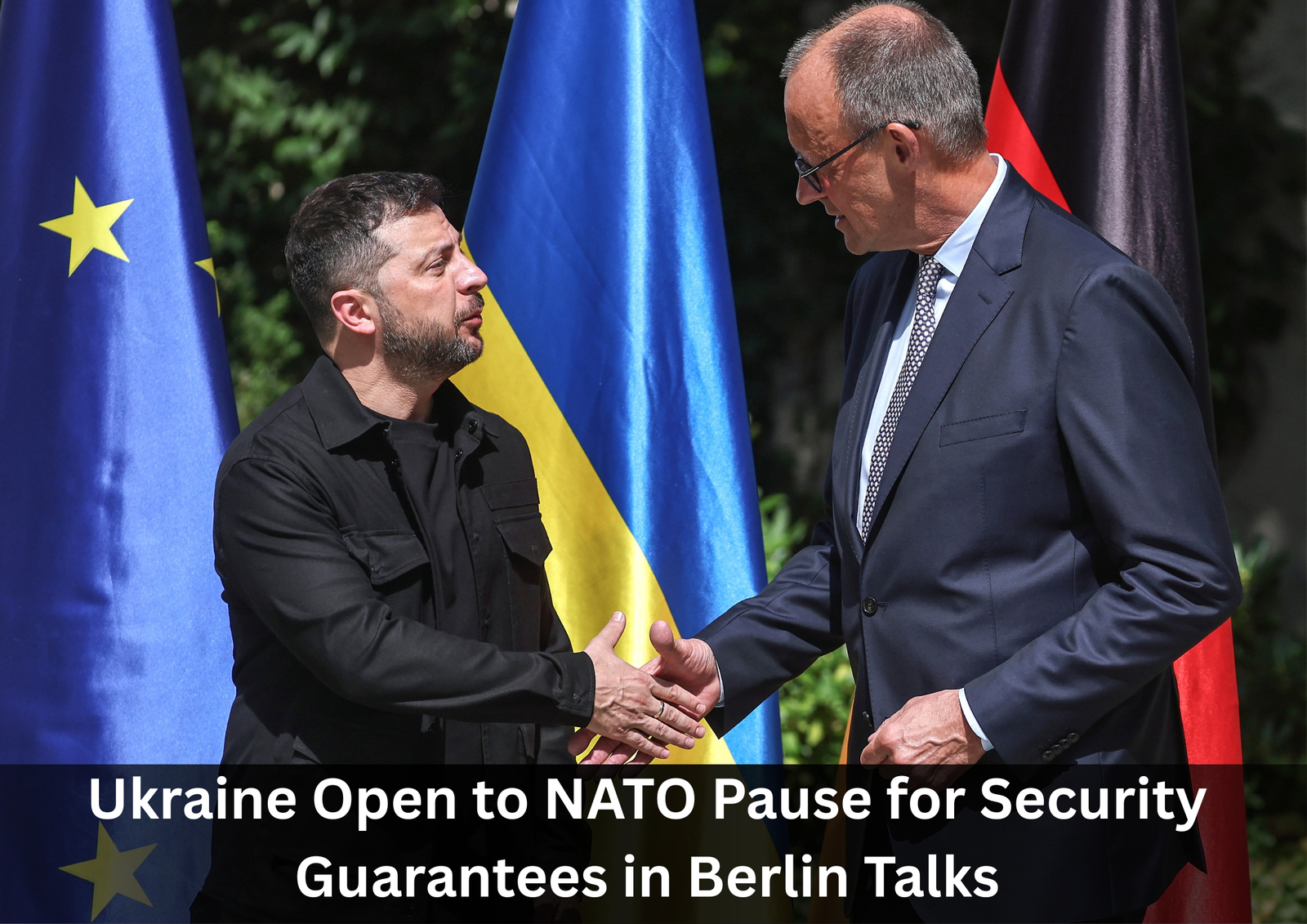
Ukraine has indicated a readiness to put its long-standing ambition of joining NATO on hold as part of a broader effort to revive peace negotiations with Russia, according to officials familiar with high-level discussions held over the weekend in Berlin. The move reflects a growing focus on alternative security arrangements designed to stabilize the region while talks over a permanent settlement continue.
The Berlin meetings brought together Ukrainian President Volodymyr Zelenskyy, senior representatives from the United States, and several European leaders, with Germany playing a central mediating role. The discussions marked one of the most substantive diplomatic efforts in months to narrow differences between Kyiv and Moscow after prolonged military and political deadlock.
At the heart of the talks was a U.S.-backed proposal offering Ukraine long-term security assurances outside the formal framework of NATO membership. American officials described the concept as a set of binding commitments from the United States and partner nations that would function similarly to NATO’s collective defense principle, without extending full alliance status to Ukraine.
Supporters of the plan argue that such guarantees could provide Kyiv with credible protection against future aggression while addressing Moscow’s long-stated opposition to NATO’s eastward expansion. U.S. representatives emphasized that the proposal is tied to progress in peace negotiations and framed it as a limited window of opportunity rather than an open-ended offer.
German Chancellor Friedrich Merz welcomed the initiative, describing it as a constructive step toward ending the conflict. In public remarks, he praised what he called a “serious and tangible security concept” and stressed Europe’s responsibility to play a stronger role in ensuring stability on the continent. Several European governments echoed that sentiment in a joint statement expressing cautious optimism about the direction of the talks.
According to diplomats briefed on the discussions, European countries are considering the formation of a multinational security presence in Ukraine as part of a post-conflict arrangement. Such a force would operate with political and logistical backing from the United States, though details about its mandate, size, and deployment timeline remain under negotiation.
Despite progress on security guarantees, territorial disputes continue to pose a major challenge. The status of eastern regions affected by the fighting, particularly in and around Donbas, remains deeply contentious. Ukrainian officials reiterated that Kyiv cannot formally relinquish territory that has not been fully occupied by Russian forces, viewing any such concession as incompatible with national sovereignty.
American mediators, meanwhile, have urged flexibility, warning that unresolved territorial questions could prolong the conflict and lead to further human and economic losses. One idea discussed during the Berlin meetings involved shared management of key infrastructure assets in contested areas, including energy facilities, as a confidence-building measure. While no final agreement was reached, negotiators described these conversations as more detailed than in previous rounds.
Officials involved in the talks suggested that many technical issues have already been narrowed or provisionally resolved, shifting attention to a smaller number of politically sensitive decisions. Follow-up discussions with Russian representatives are expected in the coming days, as U.S. envoys seek to gauge Moscow’s response to the emerging framework.
The Kremlin has reacted cautiously but signaled a willingness to continue dialogue. Russian officials said they expect a full briefing on the Berlin proposals and reiterated that any agreement must address what Moscow describes as its core security concerns. At the same time, they warned against what they characterized as symbolic negotiations designed to delay difficult compromises.
A notable element of the U.S. approach is the suggestion that any final security commitments to Ukraine could be submitted to the U.S. Senate for ratification. Advocates say this would give the guarantees greater durability and reduce uncertainty about policy changes following future elections. Analysts note that Senate approval could also strengthen confidence among European partners and investors assessing Ukraine’s long-term recovery prospects.
Beyond security arrangements, discussions also touched on Ukraine’s future relationship with the European Union. Western officials indicated that EU membership remains a viable path for Kyiv under the proposed framework, framing economic integration as a parallel track to military stabilization.
While significant hurdles remain, participants described the Berlin talks as a meaningful step toward a negotiated outcome. President Zelenskyy, speaking briefly after the meetings, said Ukraine remains committed to a just and lasting peace but emphasized that security and sovereignty must remain non-negotiable principles.
Diplomatic efforts are expected to intensify in the weeks ahead, with additional meetings planned to address unresolved border issues and implementation mechanisms. Whether the emerging proposals can bridge the remaining gaps between the parties remains uncertain, but for the first time in months, negotiators say the outlines of a possible compromise are beginning to take shape.