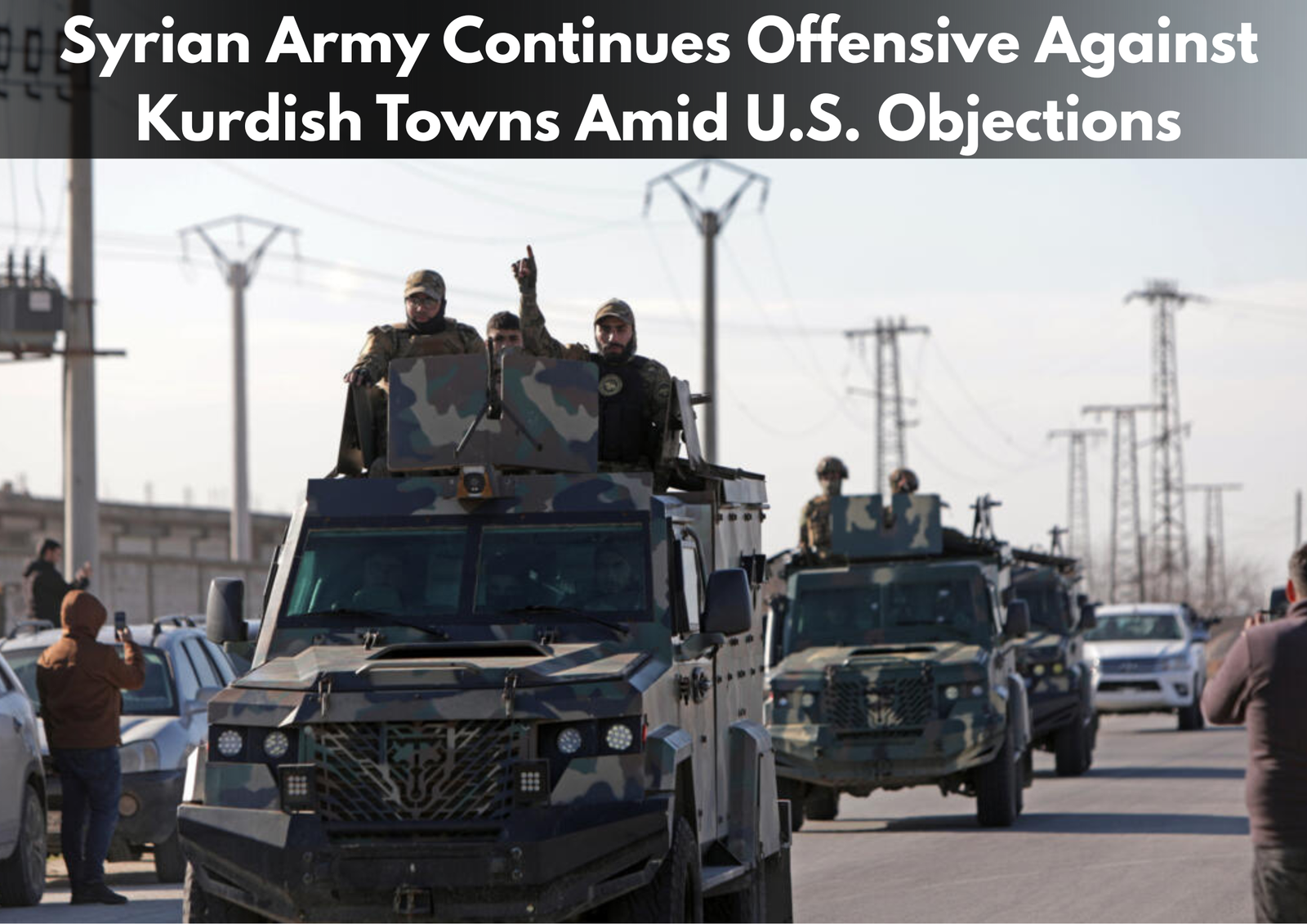
Syrian government forces have secured a series of towns, oilfields, and strategic infrastructure east of Aleppo following a withdrawal by the Kurdish-led Syrian Democratic Forces (SDF), deepening political and military tensions over the future integration of Kurdish institutions into the Syrian state. The campaign has unfolded despite calls from Washington for Damascus to halt offensive operations in the contested corridor linking Aleppo to Tabqa.
Rapid Military Gains Across Strategic Corridor
State media on Saturday announced “complete operational control” over the town of Deir Hafer, roughly 50 kilometers east of Aleppo, and reported the capture of Maskanah, Tabqa, and the Euphrates Dam-one of Syria’s most significant power-generation assets. The Syrian Petroleum Company also confirmed control over the al-Rasafa, Safyan and Thawra oilfields, providing Damascus with new leverage over the resource-rich northeast.
The United States Central Command urged Syrian forces to “cease escalatory actions” as the advances risk undermining broader diplomatic initiatives aimed at resolving long-running disputes between the government and Kurdish authorities.
Kurdish Withdrawal Spurs Accusations and Diplomatic Fallout
The SDF withdrawal began on January 17 in what its commander, Mazloum Abdi, described as a goodwill gesture encouraged by “friendly mediators” and tied to an ambitious integration deal negotiated with Damascus in March 2025. The agreement envisioned the full incorporation of Kurdish administrative and military structures into the state by the end of last year-a deadline that ultimately slipped without implementation.
After the initial pullback, Kurdish officials accused Syrian forces of pressing beyond the mutually discussed areas into Tabqa and adjacent oilfields, alleging that some SDF personnel were surrounded during the maneuver. Damascus rejected the accusations, claiming Kurdish units breached the agreement by firing on an army patrol near Maskanah and by detonating explosive devices along the Raqqa corridor. The Defense Ministry also blamed a drone strike in western Raqqa province-killing two soldiers-on groups linked to the PKK.
Mixed Local Response and Shifting Political Calculations
In towns such as Deir Hafer, where Arab tribes form the majority, residents gathered to welcome Syrian troops after weeks of uncertainty. “People are simply exhausted,” local resident Hussein al-Khalaf said. “If this brings stability, no one will oppose it.”
The realignment comes shortly after President Ahmed al-Sharaa signed a decree formally recognizing Kurdish as a national language, establishing the Kurdish New Year as a public holiday, and promising full citizenship rights-a landmark shift in state policy. Kurdish authorities described the move as a “foundation for coexistence” but insisted on constitutional guarantees to prevent future reversals.
International Mediation Attempts to Contain Crisis
The United States continues to navigate a delicate balancing act after years of supporting the SDF in the campaign against the Islamic State. U.S. Special Envoy Tom Barrack met with Mazloum Abdi and Iraqi Kurdish leader Masrour Barzani in Erbil on Saturday, while simultaneously engaging Damascus to prevent unilateral changes to the negotiated framework.
Military analysts argue that control of the SDF’s estimated 50,000 to 90,000 fighters remains the central obstacle in the integration process. Kurdish negotiators have sought autonomous defense guarantees, while Damascus insists on full command authority over all armed units.
Clashes Ongoing, Outlook Uncertain
By Saturday night, the SDF denied Syrian claims of control over Tabqa, reporting that its forces had detained agitators attempting to stir unrest. Heavy clashes were still reported near the Thawra oilfield, and a curfew was imposed in Raqqa as authorities attempted to stabilize the situation.
Syrian commanders warned civilians to avoid recently retaken operational zones until engineers clear mines and unexploded ordnance. Meanwhile, prominent Arab tribal leaders in SDF-held regions signaled willingness to mobilize fighters if ordered by Damascus, raising fears of new frontlines within communities already fractured by a decade of war.
Efforts to reinvigorate the stalled integration deal are expected to accelerate in the coming weeks. Yet with deep mistrust on all sides and competing international stakeholders, analysts caution that the current moment could either unlock a historic settlement-or trigger a renewed cycle of confrontation across northern Syria.
Iran’s Supreme Leader Admits High Protest Death Toll, Blames U.S. Leadership for Unrest – shocking revelations await, so read the full blog for deeper insight and context.